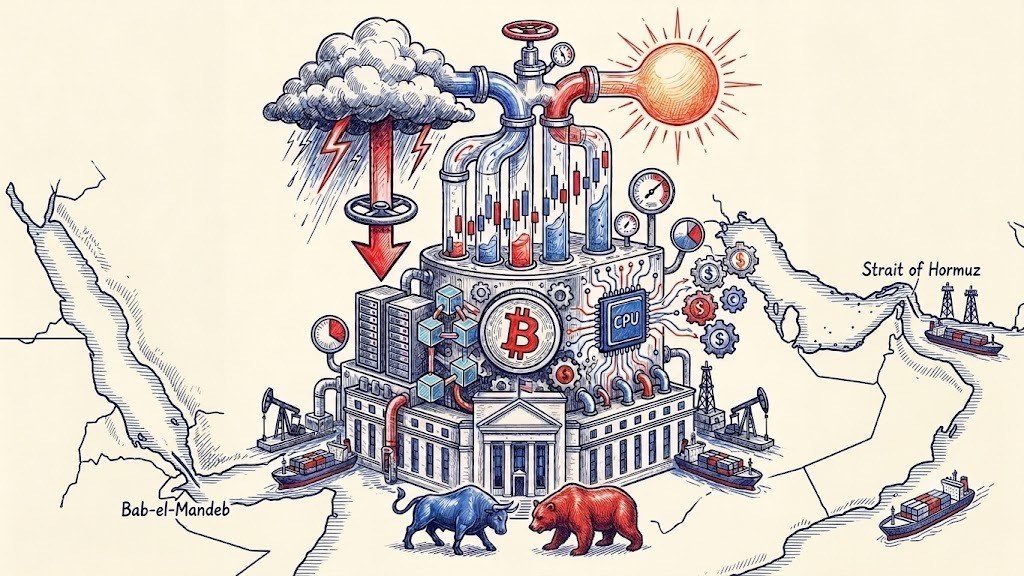
Short version: We still think 2026 finishes strongly. We also think it gets uncomfortable first. The most likely path from here is a meaningful drop somewhere between August and October, followed by a strong finish into December. Position for the turbulence. Keep the ammunition for the recovery.
What Q2 actually did
The headline was excellent. The S&P 500 had its best quarter since 2020 and is up around 11% for the year. Underneath that number, the gap between winners and losers was enormous.
- Memory chips and semiconductors led everything. A memory-focused basket is up over 100% this year, semiconductors around 38%, and technology outside the Magnificent 7 around 35%.
- The old leaders fell behind. The Magnificent 7 returned roughly 8%, less than the index itself. Financials managed about 3% and healthcare about 2%.
- Real-economy sectors worked. Energy around 25% and industrials around 16%.
- The tail was ugly. Communication services outside the mega-caps fell around 21%. Bitcoin fell about 26% and Ether about 35% while share markets were making new highs.
- Interest rate expectations swung wildly. In March, markets expected roughly two rate cuts this year. By the end of June they expected roughly 1.6 rate rises, a swing of more than three moves in three months.
- Then inflation turned. June core inflation came in slightly negative for the month against expectations of a small rise, and around 68% of the inflation basket is now falling from its peak, against a long-run average closer to a third.
Three months ago we asked whether the rally could broaden out, or whether it would stay dependent on a small group of winners. The answer was not the one most people expected. Concentration didn't end. It changed address.
Leadership moved away from the Magnificent 7 and toward the companies that supply them: memory, chips, power, industrial equipment. That is still a narrow market. It is simply a different narrow market, and this one has real order books behind it.
The Federal Reserve's July survey of regional business conditions said the same thing in plain language. Growth was reported in 11 of 12 districts. Price rises were flat or slower in every single district. Demand was concentrating in data centres, defence, machinery and automation. One business contact described it as an economy driven by companies building things rather than by consumers buying things.
Consumers kept spending, but the quality of that spending got worse, with more trading down to cheaper products, more delayed purchases, and more use of credit cards for everyday essentials.
The five things that decide the second half
- War creates turbulence, not a trend. Middle East conflict has moved oil around, but crude has stayed relatively contained near $80 after spiking. Historically, geopolitical shocks have produced sharp falls that recover. They are usually opportunities rather than reasons to leave.
- The AI story is intact. This is still the largest single driver of corporate earnings, and it benefits the United States, Korea, Taiwan, Japan and China. Nothing in Q2 broke that. What changed was which companies capture it.
- The bottlenecks are real and they haven't cleared. Memory, chips and electricity remain genuine constraints on how fast AI infrastructure can be built. That is why memory doubled while the Magnificent 7 lagged. Where supply is scarce, pricing power sits.
- The market will test the new Fed. The new Chair has deliberately stopped giving advance signals about future policy. That wild swing in rate expectations was not a malfunction, it was the new system working as designed. Roughly half the committee wants rates held or lowered; the other half wants a rise before year end.
- Borrowed money says a consolidation is needed. Margin debt is running about 54% higher than a year ago. Historically, peaks in that growth rate have preceded periods of consolidation rather than the end of bull markets. Stretched positioning is what turns an ordinary disappointment into a violent one.
Why we think the gains are back-ended
We said in January that the trend could rise this year but most of the upside would arrive later. We said the same thing in April. We are saying it a third time now, because the evidence has strengthened rather than weakened.
The pattern after three consecutive strong years has historically been a choppy middle followed by a fourth-quarter rally. That fits the current calendar. It also fits the positioning data, the policy uncertainty, and a midterm election year, which has historically delivered falls before polling day and stronger returns afterwards.
Fundstrat's Tom Lee has put a number on the same roadmap: a 10 to 20% drawdown, most likely between August and October, before the index grinds toward 8,000 by year end, with roughly a 60% probability attached. We do not treat any single forecast as gospel, but the shape matches what we have been describing since January.
It is worth noting the other side. Bank of America has a year-end target of 7,100, roughly 5% below current levels, arguing that speculation has reached extreme levels. Goldman Sachs and Citigroup sit near 8,000 and 8,100, and Ed Yardeni is at 8,250. The bulls and bears disagree on the destination far less than they disagree on the road.
What we're watching
- The physical layer. Memory, power generation, grid equipment, cooling and planning approvals. New York has introduced the first statewide ban on new large-scale data centres, so electricity and planning permission are now political questions, not just engineering ones. We think this is the most underpriced risk to the theme.
- The consumer gap. Bank executives describe a resilient consumer. The Fed's own regional survey describes trading down and weakening loan quality. Both are true. Which one wins is the question.
- Rotation inside technology. July has seen money leaving the first-half chip winners and moving back into large software and platform names. If that continues, the first-half playbook is already out of date.
- Earnings quality. With the index resting on roughly 400 in earnings and a 20 to 22 times multiple, the maths only works if profits keep delivering. Second-quarter results are the test.
Sector view, in plain English
Lean in: industrials, electrical and power infrastructure, energy and basic materials, and defence. This is where the Fed's own survey says demand is concentrating, and prices have not run as far as they have in semiconductors. Small caps belong here too if confidence broadens.
Core, but buy well: technology, semiconductors and memory. The story is intact; the share prices have already travelled a very long way. Own them, don't chase them, and let pullbacks come to you. Financials also sit here, inexpensive relative to the market, but the interest rate path genuinely cuts both ways now.
Lighter weight: consumer discretionary, where trading-down behaviour is visible in the data; communication services outside the mega-caps, the market's weakest corner; and digital assets, which fell sharply through a quarter when equities rose, a divergence worth respecting rather than explaining away.
Our view
Be constructive about the destination. Be careful about the route.
The bull case is intact: earnings are growing, inflation is cooling, and the AI build-out is a real capital cycle with real order books. But the market is being carried by a narrow, capital-hungry group at a time when borrowed money is elevated, the Fed has stopped signalling its intentions, and the consumer underneath is quietly weakening.
That combination does not usually resolve gently. It resolves with a shakeout, and then it resolves upward. So keep cash available, pre-set the levels at which you will buy rather than improvising in the moment, avoid crowded positioning, and treat an August to October drop as the entry point rather than the emergency.
Bottom line: Q1 rewarded discipline. Q2 rewarded being in the right narrow trade. The second half will reward whoever still has capital to deploy when everyone else is selling. Expect the pullback. Position for the run.
This article is general information only and does not constitute personal financial advice. It does not take into account your objectives, financial situation or needs. Past performance is not a reliable indicator of future performance. Forecasts are inherently uncertain and may not eventuate. You should consider whether the information is appropriate for you and seek independent professional advice before making any investment decision.
View on LinkedIn →